

fig3
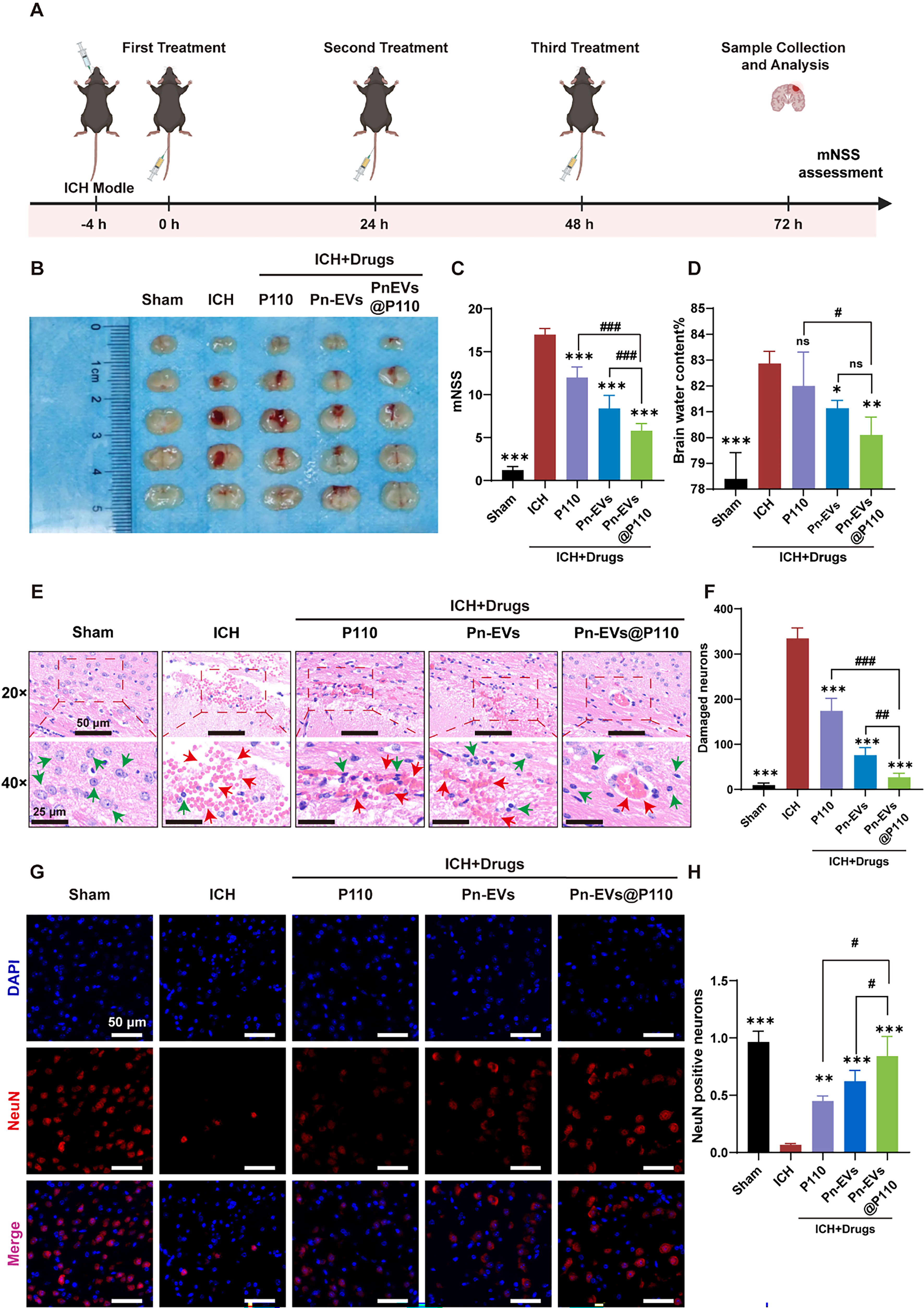
Figure 3. Pn-EVs@P110 improves neurological outcomes and reduces brain injury after the first treatment (in vivo). (A) Experimental timeline for collagenase-induced ICH model establishment, drug administration, mNSS assessment, and sample collection. Created in BioRender. Chen, B. (2026) https://BioRender.com/67tdrxr; (B) Representative whole-brain images showing hematoma in 5 groups; (C) mNSS; (D) brain water content in each group; (E) Representative H&E staining of perihematomal brain sections (20× and 40×). Arrowheads indicate injured (red)/degenerating (green) neurons and tissue damage; (F) Quantification of damaged neurons in perihematomal regions; (G) Representative immunofluorescence images of NeuN (red) and DAPI (blue) in perihematomal regions; (H) Quantification of NeuN-positive neurons. Data are presented as mean ± SD; n = 3 mice/group. *P < 0.05, **P < 0.01, ***P < 0.001 vs. ICH; #P < 0.05, ##P < 0.01, ###P < 0.001 vs. Pn-EVs or P110 as indicated by the brackets. ICH: Intracerebral hemorrhage; mNSS: modified neurological severity score; H&E: hematoxylin and eosin; NeuN: neuronal nuclei; DAPI: 4’,6-diamidino-2-phenylindole; Pn-EVs: Panax notoginseng-derived extracellular vesicle-like nanovesicles; SD: standard deviation; ns: not significant.